Dough
78%
Hydration
Wet, almost batter-like. A long cold ferment builds flavor and lets the dough relax enough to be stretched gently into the pan.
Older than pizza. Liguria's focaccia is what bakers made on the days when flour, water, oil, and salt were all they had. Dimples for pools of oil, sea salt on top, a tender crumb that's chewy at the bottom and pillowy at the heart.
Focaccia's name comes from the Latin focus — hearth. The original was an unleavened flatbread baked on the stones at the bottom of a wood-fired oven, made to test whether the oven was hot enough for bread.
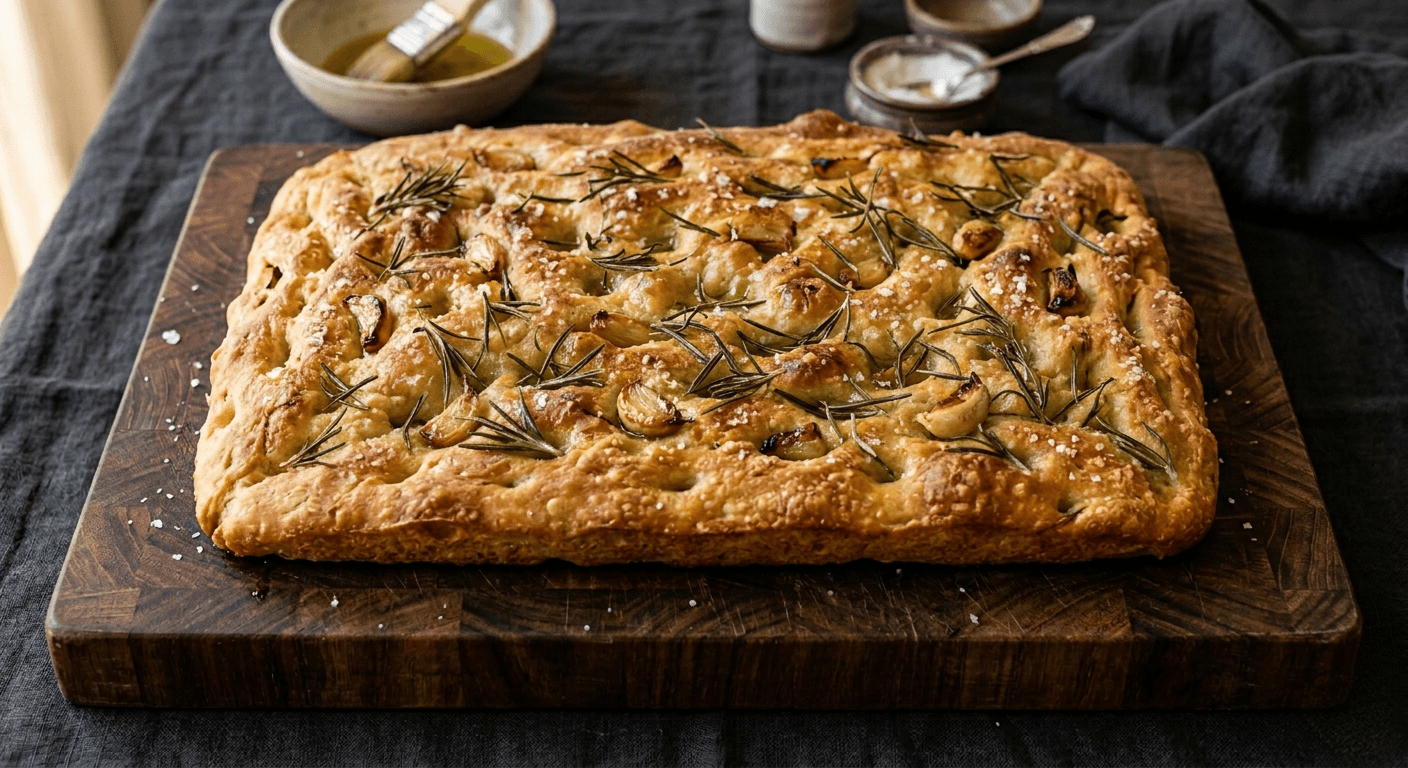
Liguria's coastline elaborated it: focaccia genovese is rich with olive oil, dimpled with the baker's fingers to hold pools that crackle in the bake, salted on top with crystallized sea salt. Other regions added their own marks — Pugliese with cherry tomatoes and olives, Barese stuffed.
The technique is in the hands and the time: a wet dough that proofs slowly, gentle stretching in the pan, the dimples pressed in just before bake so they hold their depth. The bake is forgiving — a domestic oven is plenty.
High-hydration bread-flour dough (~78%) proofed long and cold. Generously oiled half-sheet pan. Dimples pressed in with oiled fingertips just before bake. Topped at minimum with EVOO, flaky sea salt, and rosemary. 425–450°F for 20–25 minutes.
Wet, almost batter-like. A long cold ferment builds flavor and lets the dough relax enough to be stretched gently into the pan.
Stretches to fill a standard 13×18 half-sheet. Slow proof in the oiled pan (1–2 hours after cold ferment), dimples pressed in just before baking.
Standard home oven, middle rack. The pools of olive oil in the dimples crackle and caramelize at the rim; the sea salt stays crystallized on top.
Salamoia — warm water, olive oil, and salt whisked cloudy — poured into the dimples, rosemary pressed into the wells, flaky salt on top. Liguria's everyday bread, and the only version with rules.
Cherry tomatoes and olives pressed hard into the dimples so they half-roast into the crumb, oregano over the top. No cheese — the tomato juice does that job.
Opens the dough calculator with focaccia pre-selected. Pick your pan dimensions and a long cold ferment; we'll handle the high-hydration math and the proof timing.
The topping calculator opens with focaccia genovese preconfigured — salamoia, rosemary, and flaky salt, scaled to your pan.
Three questions on budget, space, and how often you bake — we'll recommend a curated equipment build to get you started.